
Chapter 5 (English)
 Topic wise chapter (English)
2. Access methods
File Access Methods
File access methods are techniques used by an OS to read and write data in files. They define how information is organized, retrieved, and modified. Choosing the right method is important for performance and data management.
There are three ways to access a file in a computer system:
- Sequential-Access
- Direct Access
- Index sequential Method
Sequential Access
A file access method where data is read or written in order, one record after another, starting from the beginning. The file pointer moves forward automatically after each operation.

Key Points related to Sequential Access
- Data is accessed from one record right after another record in an order.
- When we use the read command, it moves ahead pointer by one.
- When we use the write command, it will allocate memory and move the pointer to the end of the file.
- Such a method is reasonable for tape.
Advantages of Sequential Access Method
- It is simple to implement this file access mechanism.
- It uses lexicographic order to quickly access the next entry.
- It is less prone to data corruption as the data is written sequentially and not randomly.
Disadvantages of Sequential Access Method
- Slow for searching specific records.
- Inserting/updating in the middle is difficult.
- Can waste storage if records have varying lengths.
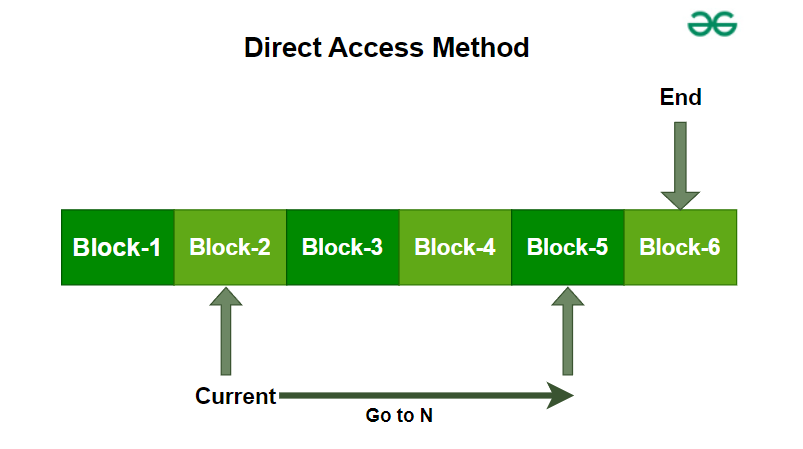
Direct Access Method
A file access method that allows data to be read or written directly at any block or record, using its address (block number). It supports random access without scanning previous records.
Advantages of Direct Access Method
- The files can be immediately accessed decreasing the average access time.
- In the direct access method, in order to access a block, there is no need of traversing all the blocks present before it.
Disadvantages of Direct Access Method
- Complex Implementation : Implementing direct access can be complex, requiring sophisticated algorithms and data structures to manage and locate records efficiently.
- Higher Storage Overhead : Direct access methods often require additional storage for maintaining data location information (such as pointers or address tables), which can increase the overall storage requirements.
Index Sequential method
It is the other method of accessing a file that is built on the top of the sequential access method. These methods construct an index for the file. The index, like an index in the back of a book, contains the pointer to the various blocks. To find a record in the file, we first search the index, and then by the help of pointer we access the file directly.

Key Points Related to Index Sequential Method
- It is built on top of Sequential access.
- It control the pointer by using index.
Advantages of Index Sequential Method
- Fast Searching: Index enables quick lookups.
- Flexible: Supports both sequential and random access.
- Reduced Access Time: Quickly locates data in large files.
Disadvantages of Index Sequential Method
- Complexity: Harder to implement and maintain than sequential access.
- Extra Storage: Requires additional space for indexes.
- Slower Updates: Both data and index must be updated during insertions, deletions, or modifications.
- Maintenance Overhead: Indexes need frequent updates in dynamic environments.
Other Way of File Access
1. Relative Record Access
Relative record access is a file access method used in operating systems where records are accessed relative to the current position of the file pointer. In this method, records are located based on their position relative to the current record, rather than by a specific address or key value.
Key Points Related to Relative Record Access
- Relative record access is a random access method that allows records to be accessed based on their position relative to the current record.
- This method is efficient for accessing individual records but may not be suitable for files that require frequent updates or random access to specific records.
- Relative record access requires fixed-length records and may not be flexible enough for some applications.
- This method is useful for processing records in a specific order or for files that are accessed sequentially.
Advantages of Relative Record Access
- Random Access: Allows direct access to any record by moving the file pointer to a specific offset.
- Efficient Retrieval: Faster than sequential access when accessing individual records since only required records are read.
- Sequential Use: Useful for ordered processing (e.g., accessing next/previous records in sorted files).
Disadvantages of Relative Record Access
- Fixed Record Length: Requires equal-sized records; padding may be needed.
- Low Flexibility: Hard to insert or delete records without disturbing others.
- Limited Use: Suitable for regular/sequential access, but not for frequent updates or random access.
2. Content Addressable Access
Content-addressable access (CAA) is a file access method used in operating systems that allows records or blocks to be accessed based on their content rather than their address. In this method, a hash function is used to calculate a unique key for each record or block, and the system can access any record or block by specifying its key.
Keys in Content-Addressable Access
- Unique: Each record or block has a unique key that is generated using a hash function.
- Calculated based on content: The key is calculated based on the content of the record or block, rather than its location or address.
Key Points Related to Content-Addressable Access
- Content-addressable access is a file access method that allows records or blocks to be accessed based on their content rather than their address.
- CAA uses a hash function to generate a unique key for each record or block.
- CAA is efficient for searching large databases or file systems and is more flexible than other access methods.
- CAA requires additional overhead for calculating the hash function and may have collisions or limited key space.
Advantages of Content-Addressable Access
- Efficient Search: CAA is ideal for searching large databases or file systems because it allows for efficient searching based on the content of the records or blocks.
- Flexibility: CAA is more flexible than other access methods because it allows for easy insertion and deletion of records or blocks.
- Data Integrity : CAA ensures data integrity because each record or block has a unique key that is generated based on its content.
Disadvantages of Content-Addressable Access
- Overhead: CAA requires additional overhead because the hash function must be calculated for each record or block.
- Collision: There is a possibility of collision where two records or blocks can have the same key. This can be minimized by using a good hash function, but it cannot be completely eliminated.
- Limited Key Space: The key space is limited by the size of the hash function used, which can lead to collisions and other issues.