
Chapter 2 (English)
 Topic Wise Chapter in English
7. Critical section
Critical Section in Synchronization
A critical section is a part of a program where shared resources (like memory, files, or variables) are accessed by multiple processes or threads. To avoid problems such as race conditions and data inconsistency, only one process/thread should execute the critical section at a time using synchronization techniques. This ensures that operations on shared resources are performed safely and predictably.
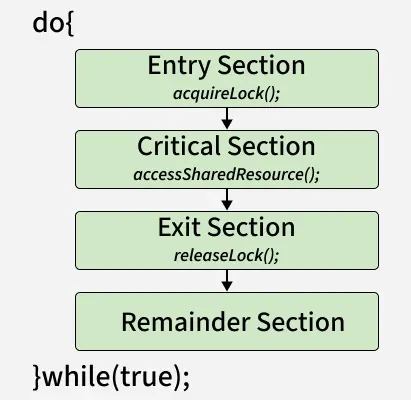
Structure of a Critical Section
1. Entry Section
- The process requests permission to enter the critical section.
- Synchronization tools (e.g., mutex, semaphore) are used to control access.
2. Critical Section: The actual code where shared resources are accessed or modified.
3. Exit Section: The process releases the lock or semaphore, allowing other processes to enter the critical section.
4. Remainder Section: The rest of the program that does not involve shared resource access.
Critical Section Problem
Shared Resources and Race Conditions
- Shared resources include memory, global variables, files, and databases.
- A race condition occurs when two or more processes attempt to update shared data at the same time, leading to unexpected results. Example: Two bank transactions modifying the same account balance simultaneously without synchronization may lead to incorrect final balance.
It could be visualized using the pseudo-code below
do{
flag=1;
while(flag); // (entry section)
// critical section
if (!flag)
// remainder section
} while(true);
Requirements of a Solution
A good critical section solution must ensure:
- Correctness - Shared data should remain consistent.
- Efficiency - Should minimize waiting and maximize CPU utilization.
- Fairness - No process should be unfairly delayed or starved.
Requirements of Critical Section Solutions
1. Mutual Exclusion
- At most one process can be inside the critical section at a time.
- Prevents conflicts by ensuring no two processes update the shared resource simultaneously.
2. Progress
- If no process is in the critical section, and some processes want to enter, the choice of who enters next should not be postponed indefinitely.
- Ensures that the system continues to make progress rather than getting stuck.
3. Bounded Waiting
- There must be a limit on how long a process waits before it gets a chance to enter the critical section.
- Prevents starvation, where one process is repeatedly bypassed while others get to execute.
Example Use Case: Older operating systems or embedded systems where simplicity and reliability outweigh responsiveness.
Solution to Critical Section Problem :
A simple solution to the critical section can be thought of as shown below,
acquireLock();
Process Critical Section
releaseLock();
A thread must acquire a lock prior to executing a critical section. The lock can be acquired by only one thread. There are various ways to implement locks in the above pseudo-code.
Examples of critical sections in real-world applications
Banking System (ATM or Online Banking)
- Critical Section: Updating an account balance during a deposit or withdrawal.
- Issue if not handled: Two simultaneous withdrawals could result in an incorrect final balance due to race conditions.
Ticket Booking System (Airlines, Movies, Trains)
- Critical Section: Reserving the last available seat.
- Issue if not handled: Two users may be shown the same available seat and both may book it, leading to overbooking.
Print Spooler in a Networked Printer
- Critical Section: Sending print jobs to the printer queue.
- Issue if not handled: Print jobs may get mixed up or skipped if multiple users send jobs simultaneously.
File Editing in Shared Documents (e.g., Google Docs, MS Word with shared access)
- Critical Section: Saving or writing to the shared document.
- Issue if not handled: Simultaneous edits could lead to conflicting versions or data loss.