
Topic Wise Lesson Plan

Introduction to IoT:
What is IoT?
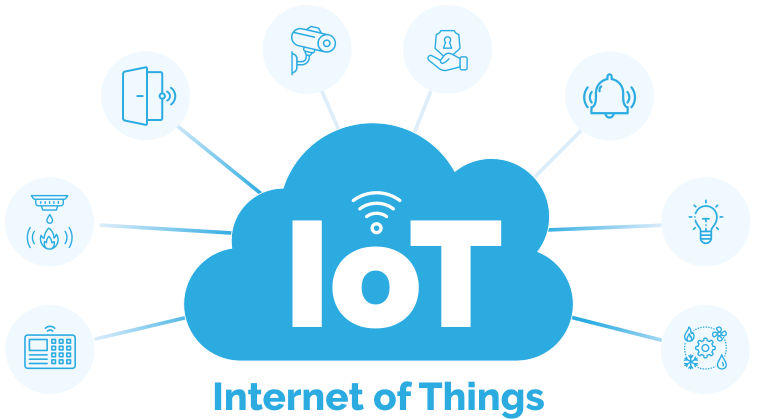
The Internet of Things (IoT) refers to a network of physical objects—called things—that are embedded with sensors, software, and connectivity so they can collect, exchange, and act on data over the internet without human intervention.
Simple idea:
If an object can sense something and connect to the internet, it can be part of IoT.
Examples of IoT in Everyday Life
-
Smart homes: smart lights, thermostats, door locks
-
Wearables: fitness trackers, smartwatches
-
Smart vehicles: GPS tracking, autonomous driving features
-
Healthcare: remote patient monitoring
-
Agriculture: soil moisture sensors, smart irrigation
-
Industry: predictive maintenance, smart factories
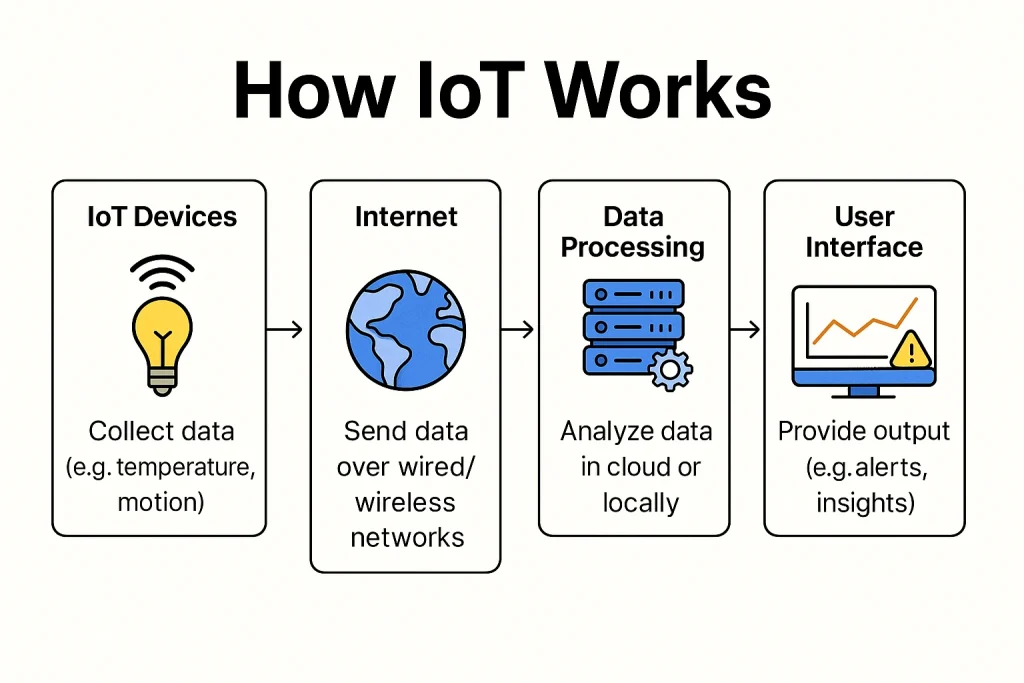
How IoT Works (Basic Architecture)
-
Devices / Sensors
Collect data (temperature, motion, heart rate, etc.) -
Connectivity
Data is sent via Wi-Fi, Bluetooth, cellular, LPWAN, etc. -
Data Processing
Data is processed locally or in the cloud -
User Interface / Action
Results are shown on apps or dashboards, or actions are triggered automatically
Key Components of IoT
-
Sensors & Actuators – sense and act on the environment
-
Embedded Systems – microcontrollers like Arduino, ESP32
-
Communication Protocols – MQTT, HTTP, CoAP
-
Cloud Platforms – AWS IoT, Azure IoT, Google Cloud
-
Applications – mobile or web apps for users
Benefits of IoT
-
Automation and efficiency
-
Real-time monitoring
-
Cost savings
-
Better decision-making
-
Improved quality of life
Challenges of IoT
-
Security and privacy risks
-
Connectivity issues
-
Power consumption
-
Data management and scalability
-
Device maintenance
Future of IoT
IoT is evolving with AI, 5G, edge computing, and big data, enabling smarter cities, autonomous systems, and personalized healthcare.
Sensors:
Sensors are devices that detect and measure physical properties, such as temperature, humidity, light, motion, pressure, or sound. They convert these physical phenomena into digital signals that can be transmitted and processed by other devices or systems. Sensors are the input devices in IoT systems, gathering real-world data.
/filters:no_upscale()/articles/iot-sensors-enterprise/en/resources/1Sensors_img-1645633720457.jpeg)
Types of Sensors in IoT:
-
Temperature sensors: Measure temperature changes (e.g., thermocouples, thermistors).
-
Humidity sensors: Detect moisture levels in the air (e.g., capacitive or resistive humidity sensors).
-
Motion sensors: Detect movement (e.g., passive infrared sensors, ultrasonic sensors).
-
Light sensors: Measure light intensity (e.g., photodiodes, LDRs).
-
Pressure sensors: Measure pressure changes (e.g., piezoelectric or capacitive sensors).
-
Gas sensors: Detect the presence of gases like CO2, CO, or methane.
- Proximity sensors: Detect the presence or absence of objects within a certain range.
Role In IoT:
-
Collect real-time data about the environment.
-
Enable smart devices to understand the conditions around them.
-
Provide inputs to cloud platforms or local controllers for analysis and decision-making.
Actuator:
Actuators are devices that carry out actions based on commands they receive, often as a response to sensor data. They convert electrical signals into physical actions, such as movement, sound, or light.
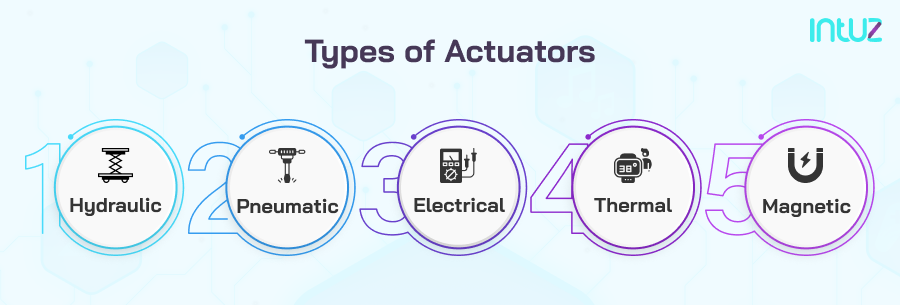
Types of Actuators:
-
-
Electric Actuators: Use electrical energy to produce motion or force (e.g., motors).
-
Hydraulic Actuators: Use pressurized fluid to create movement (e.g., in industrial machinery).
-
Pneumatic Actuators: Use compressed air for movement (common in robotics).
-
Thermal Actuators: Respond to temperature changes and might trigger heating or cooling systems.
- Magnetic Actuators:
-
Example of Actuator in IoT:
-
Motors: For mechanical movement (e.g., DC motors, stepper motors).
-
Solenoids: Provide linear motion (e.g., to control valves).
-
Relays: Open or close electrical circuits (often used to control other devices).
-
Heaters: To regulate temperature.
-
Lights (LEDs): For visual signaling or feedback.
-
Speakers: For sound output.
-
Vibrators: For haptic feedback.