Chapter:-5 (Hindi)
| Site: | AssessmentKaro |
| Course: | Database Management System |
| Book: | Chapter:-5 (Hindi) |
| Printed by: | Guest user |
| Date: | Saturday, 18 July 2026, 4:52 PM |
Description
 Topic Wise Chapter (Hindi)
1. MySQL
MySQL
MySQL एक open-source Relational Database Management System (RDBMS) है।
यह SQL (Structured Query Language) का उपयोग करके data को tables (rows और columns) में store, organize और manage करता है।
Simple words में:
👉 MySQL एक software है जो data को सही और व्यवस्थित तरीके से store और manage करता है।
Uses:
- Web applications
- Software systems
- Enterprise projects
Advantages: Fast, reliable, easy to use, open-source
2. Types of SQL Commands
Types of SQL Commands
1. DDL – Data Definition Language
DDL commands का उपयोग database structure को define या modify करने के लिए किया जाता है।
Commands:
- CREATE – नया table या database बनाता है
- ALTER – existing table का structure बदलता है
- DROP – table या database को permanently delete करता है
- TRUNCATE – table के सभी records हटाता है (structure same रहता है)
Example:
CREATE TABLE Student ( id INT, name VARCHAR(50) );
2. DML – Data Manipulation Language
DML commands का उपयोग table के अंदर data को change करने के लिए किया जाता है।
Commands:
- INSERT – नया record add करता है
- UPDATE – existing record modify करता है
- DELETE – record remove करता है
Example:
INSERT INTO Student VALUES (1, 'Asha');
3. DQL – Data Query Language
DQL commands का उपयोग data retrieve (निकालने) के लिए किया जाता है।
Command:
- SELECT
Example:
SELECT * FROM Student;
SQL Commands Summary Table
|
Type |
Purpose |
Commands |
|
DDL |
Structure define करना |
CREATE, ALTER, DROP, TRUNCATE |
|
DML |
Data change करना |
INSERT, UPDATE, DELETE |
|
DQL |
Data retrieve करना |
SELECT |
3. Operators
Operators
Operators ऐसे symbols होते हैं जो data पर कोई operation perform करते हैं।
Simple words में:
👉 Operators values पर काम करके result निकालते हैं।
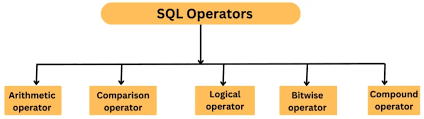
4. Arithmetic Operators
Arithmetic Operators
Use: Mathematical calculations
Examples: + - * / %
Advantages:
- Simple और fast calculations
- Easy to understand
Disadvantages:
- Division by zero error
- Sirf numeric data के लिए
5. Relational (Comparison) Operators
Relational (Comparison) Operators
Use: दो values की comparison करना (true / false)
Examples: == != > < >= <=
Advantages:
- Decision making में helpful
- if, while conditions में use
Disadvantages:
- Wrong comparison से logical error
- Floating values में problem
6. Logical Operators
Logical Operators
Use: Multiple conditions को combine करना
Examples: && (AND), || (OR), ! (NOT)
Advantages:
- Complex conditions possible
Disadvantages:
- Debug करना difficult
- Overuse से confusion
7. Assignment Operators
Assignment Operators
Use: Variable को value assign करना
Examples: = += -= *= /=
Advantages:
- Code छोटा बनता है
- Readability better होती है
Disadvantages:
- Important value overwrite हो सकती है
8. Unary Operators
Unary Operators
Use: Single operand पर काम करते हैं
Examples: ++ -- ! -
Advantages:
- Counters के लिए useful
Disadvantages:
- Pre/Post increment confusing
9. Bitwise Operators
Bitwise Operators
Use: Bit level operations
Examples: & | ^ ~ << >>
Advantages:
- Fast low-level operations
Disadvantages:
- Samajhna mushkil
- Rarely used
10. Conditional (Ternary) Operator
Conditional (Ternary) Operator
Use: if-else का short form
Syntax:
condition ? value1 : value2
Advantages:
- Short और concise
Disadvantages:
- Complex logic के लिए suitable नहीं
11. Special Operators
Special Operators
Use: Special purposes के लिए
Examples:
- sizeof
- , (comma)
- . (member access)
Advantages:
- Extra functionality
Disadvantages:
- Language-specific
- Beginners के लिए confusing
12. Operators Quick Table
📌Table (Quick View)
|
Operator Type |
Main Use |
|
Arithmetic |
Calculations |
|
Relational |
Comparison |
|
Logical |
Condition combining |
|
Assignment |
Value assignment |
|
Unary |
Single operand operations |
|
Bitwise |
Bit-level operations |
|
Conditional |
Short decision making |
|
Special |
Special purposes |